
Most residential driveways and walkways are a great fit for robotic clearing. Here’s what tends to matter, and what we confirm in person before anything is installed.
Surfaces
Asphalt and concrete are ideal. Gravel is a real conversation: Yarbo’s official guidance is paved surfaces. In practice the adjustable intake can ride above the stones (roughly two inches) to skim a gravel drive, and the chute is metal — but we’ll be straight with you about whether yours is a good candidate before anything is installed.
Driveway shapes
Straight, L-shaped, and wide double drives map as standard zones. Circular and semicircular driveways get Spiral Mode — the robot circles the center for quick, even coverage instead of fighting the curve with straight rows. Walkways and the public sidewalk map as their own zones with their own settings, all cleared in one run.
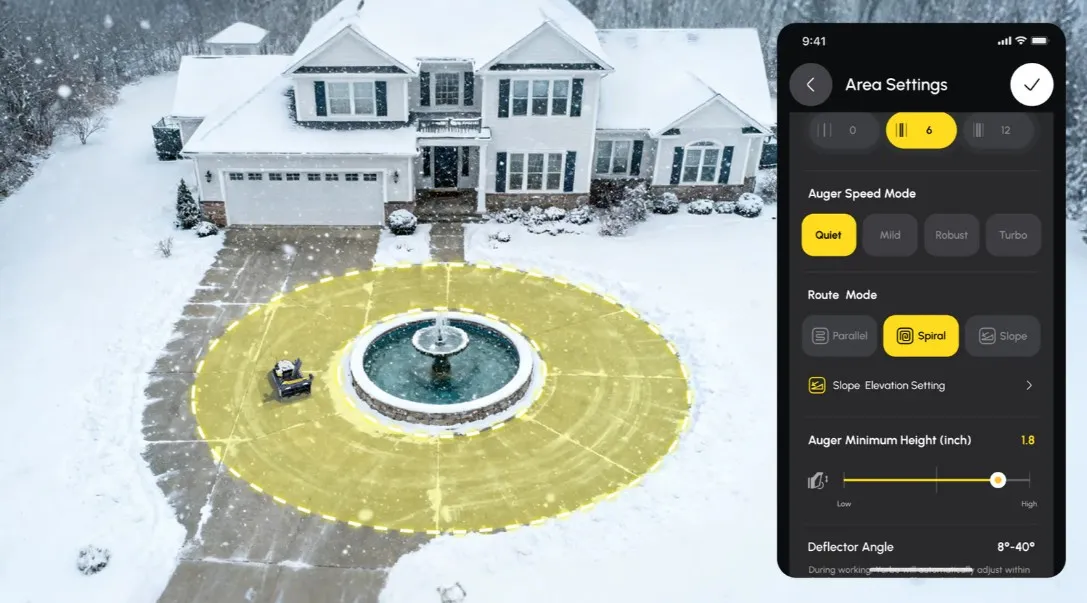
Slopes and traction
The robot runs on steel-spiked tracks with a deep tread designed for snow and ice, so typical residential grades are fine. Steep or complicated slopes are exactly the kind of thing the site assessment exists to check.
Size
By Yarbo’s published numbers, the snow module clears a 24-inch swath and covers roughly 6,000 square feet of one-inch snow on a charge — and it recharges itself and goes back out. Long drives and generous walkway networks are well within range; we’ll size the plan to the property.
What the assessment covers
Your local crew walks the property, checks surfaces, slopes, obstacles, and layout, plans where thrown snow should land, and confirms connectivity. If something about the property won’t work well, we’ll tell you straight — before you’ve spent anything.
Want a head start right now? Trace your driveway from satellite — free, about two minutes — and you’ll see the square footage, a clear-time estimate, and the sky view that matters for the RTK antenna. Then book the site assessment for the definitive answer.
Wondering if your driveway qualifies? Find out in about two minutes.